OPEN FIRE
Roasting Sticks Bend and Drop the Marshmallow
THE SHORT ANSWER
A telescoping skewer loses most of its stiffness at the last two joints, so the fix that costs nothing is to use it partly collapsed and stand closer to the fire. Support the stick with your second hand near the midpoint rather than gripping only the handle, and keep the load light — one marshmallow per fork tine, not three. If a stick has developed a permanent bend it will never straighten properly and should be retired.
pitandsear participates in the Amazon Services LLC Associates Program. If you buy through a link on this page we may earn a commission at no extra cost to you. Full disclosure.
Check these first (they cost nothing)
- Try the stick partly collapsed. Telescoping skewers lose most of their stiffness at the last two joints, and running them at two thirds extension removes most of the droop.
- Support it near the midpoint with your second hand rather than gripping only the handle. A stick held at one end is a lever working against you.
- Count what is on the end. One marshmallow per tine — three loaded onto a two-prong fork is well past what a thin tube was designed to carry.
- Check for a permanent bend. Sight down the shaft; if it is already curved with nothing on it, the metal has yielded and it will never come back.
What's actually causing it
These are ordered deliberately. Number one is the cause that turns out to be the answer most often, so work down the list rather than jumping to the one that sounds most dramatic.
Fully extended telescoping shaft
Most commonHow to confirm it
Collapse the stick to two thirds and load it the same way. If the droop largely disappears, the length was the whole problem.
How to fix it
- Use the skewer at partial extension and stand a step closer to the fire.
- Build a proper cooking zone by raking coals aside so you do not need the extra reach in the first place.
- Support the shaft near the midpoint with your free hand.
- Keep the tip slightly above horizontal so gravity is not working across the full length.
Repair or replace — Fix it yourself by using less of the stick. Costs nothing and it is the fix in most cases.
Thin-walled tubing that was never stiff enough
CommonHow to confirm it
Extend it fully with nothing on the end and press the tip gently against a table. A stick that visibly bows under light hand pressure has tubing too thin for the job.
How to fix it
- Test any replacement the same way before buying — extend it fully and press the tip.
- Look for heavier wall thickness rather than more length; length is the easy spec to advertise.
- Choose 30–45 inches extended. Under 30 puts your forearms in the radiant heat, over 45 makes the tip hard to aim regardless of stiffness.
- Retire the current stick rather than persevering with it.
Repair or replace — Replace it. Wall thickness is not something you can add, and a stick that flexes is harder for a child to control safely.
What you'll need
 Best Overall
MalloMe
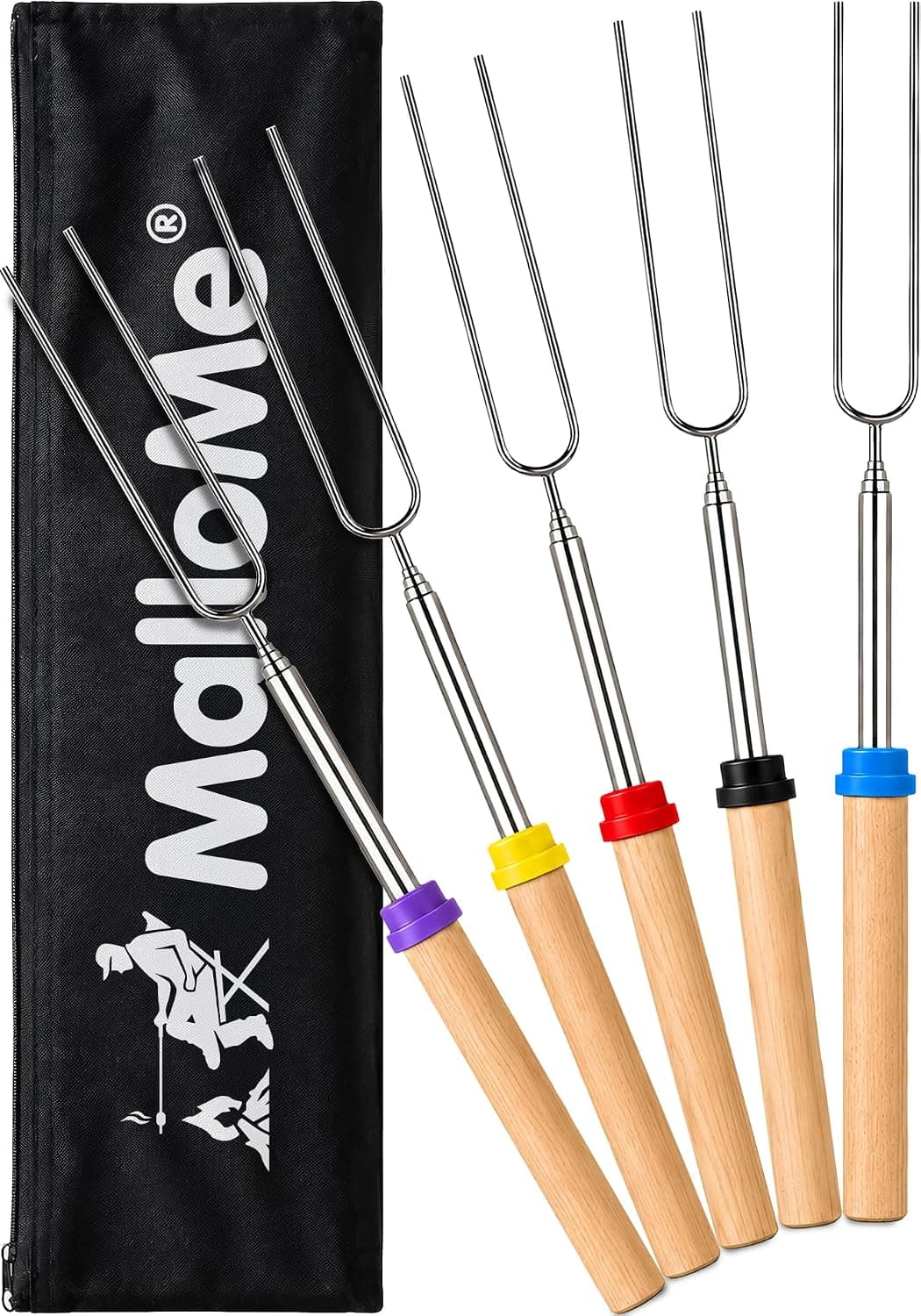
MalloMe Roasting Sticks, 32 inch, 5-pack
Best for family s’mores nights
Five telescoping steel skewers at 32 inches extended, which is the length that keeps forearms clear of the radiant heat of a normal fire pit without making the tip hard to aim. Collapsing them is what makes a set of five practical to store. Built for marshmallows and hot dogs alike, so the prong design handles food that would spin on a single point.
32 in extended, 5-pack, telescoping steel
The stick already has a permanent bend
CommonHow to confirm it
Sight down the shaft with nothing loaded. A visible curve means the metal has yielded past its elastic limit, usually from being leaned on or stored under something.
How to fix it
- Do not attempt to straighten it — bending it back work-hardens the metal and it will fail at that point.
- Retire it from cooking use.
- Store replacements flat or hanging rather than leaning in a corner, which is how most permanent bends start.
- Collapse telescoping sticks only when they are clean; grit in the tube is what makes joints seize and forces people to lever them.
Repair or replace — Replace it. A yielded shaft is done, and straightening attempts make it weaker rather than stronger.
What you'll need
How to choose barbecue forks & roasting skewers →Heat softening the shaft near the tip
CommonHow to confirm it
The bend is concentrated in the last few inches and it got worse over one evening. Holding a thin steel tube directly in flame for long periods softens it.
How to fix it
- Roast over coals rather than over flame — six inches above glowing embers, not eighteen inches above a burning log.
- Keep the shaft out of the flame; only the food end should be near the heat.
- Rotate rather than parking the stick in one position over the fire.
- Let the stick cool on a stone or metal tray rather than resting the hot end on the ground where grit sticks to it.
Repair or replace — Fix it yourself by changing where you hold it. A stick that lives in flame will keep softening whatever it is made of.
Grit or corrosion in the telescoping joints
Less commonHow to confirm it
The sections no longer slide smoothly, or they lock at an intermediate position. Grit and corrosion between tubes stop the joints seating properly, so the shaft flexes at the gap.
How to fix it
- Extend the stick fully and wash the exposed sections with hot soapy water, then dry thoroughly.
- Wipe each section with a lightly oiled cloth before collapsing it.
- Never store a telescoping stick collapsed while it is wet or dirty.
- Replace any stick where the joints have corroded enough that sections will not seat fully.
Repair or replace — Fix it yourself with a wash. Once corrosion has pitted the mating surfaces the stick is finished.
All the causes side by side
| Cause | How to confirm | Fix time | Part needed | Difficulty |
|---|---|---|---|---|
| Fully extended telescoping shaft | Collapse the stick to two thirds and load it the same way. If the droop largely disappears, the length was the whole problem. | 1 minute | None | Easy |
| Thin-walled tubing that was never stiff enough | Extend it fully with nothing on the end and press the tip gently against a table. A stick that visibly bows under light hand pressure has tubing too thin for the job. | 5 minutes | Barbecue Forks & Roasting Skewers | Easy |
| The stick already has a permanent bend | Sight down the shaft with nothing loaded. A visible curve means the metal has yielded past its elastic limit, usually from being leaned on or stored under something. | 2 minutes | Barbecue Forks & Roasting Skewers | Easy |
| Heat softening the shaft near the tip | The bend is concentrated in the last few inches and it got worse over one evening. Holding a thin steel tube directly in flame for long periods softens it. | 5 minutes | None | Easy |
| Grit or corrosion in the telescoping joints | The sections no longer slide smoothly, or they lock at an intermediate position. Grit and corrosion between tubes stop the joints seating properly, so the shaft flexes at the gap. | 15 minutes | None | Moderate |
Stop it from coming back
Sag is mostly a leverage problem, so the habits that prevent it are about using less of the stick. Run telescoping skewers at two thirds extension, support the shaft near its midpoint with your free hand, keep one marshmallow per tine, and stand close enough to a proper coal bed that you do not need the extra reach. A stick used that way never gets loaded hard enough to yield.
The maintenance side is short but it matters: wash and dry the prongs after every use because sugar carbonizes and holds moisture against the steel, wipe the sections before collapsing them so grit never gets between the tubes, and store the sticks flat or hanging rather than leaning in a corner. Leaning is how most permanent bends start, and a shaft that has yielded cannot be straightened back into service.
Related problems
OPEN FIRE
Hot Dogs Keep Falling Off the Skewer
OPEN FIRE
Campfire Is Too Hot to Roast Anything Properly
CORROSION & WEATHER
Rust on the Grill Grates
SPACE & SAFETY
Scorched Grass and Heat Marks Under the Grill
Questions people actually ask
You can bend it back, but you should not. Working the metal back and forth hardens it at the bend and it becomes a weak point that will fail there — often while a child is holding it over a fire. A permanently bent stick should be retired.
Thirty to forty-five inches extended suits most fire pits. Below thirty inches you are standing close enough that the radiant heat is uncomfortable on your forearms. Above forty-five, leverage makes the tip wander no matter how stiff the shaft is, and stiffness itself falls off with length.
Green hardwood cut on site is stiff, free and disposable, but it burns through, it can splinter into food, and you need to know the species is safe. Metal is reusable and predictable. The honest answer is that a well-made metal stick is better and a cheap thin-walled one is worse.
Two reasons. The joints loosen slightly with repeated extension and collapse, and if you have been holding the shaft in the flame rather than over coals, the last few inches soften. Roasting over embers instead of flame fixes the second one entirely.
Two — one per tine. Loading three or four onto a fork designed for two puts the weight further out and multiplies the leverage on a thin tube. It also cooks unevenly, since the outer ones shield the inner ones from the heat.
Sources
pitandsear participates in the Amazon Services LLC Associates Program. If you buy through a link on this page we may earn a commission at no extra cost to you. Full disclosure.