HEAT & FIRE
Smoker Temperature Keeps Swinging Up and Down
THE SHORT ANSWER
A swing of more than about 25°F either side of your target usually means you are adding fuel in large lumps and then chasing the spike with the vents. Switch to smaller, more frequent fuel additions, set the intake vent to a fixed position and control almost nothing else, and stop opening the lid — every lid lift costs roughly 10–15 minutes of recovery. A leaky door gasket and a thin firebox make the problem worse but are rarely the whole story.
pitandsear participates in the Amazon Services LLC Associates Program. If you buy through a link on this page we may earn a commission at no extra cost to you. Full disclosure.
Check these first (they cost nothing)
- Count how many times you opened the lid in the last hour. Every lid lift costs roughly 10–15 minutes of recovery, and four of them will produce a chart that looks like a fault.
- Check where you are measuring. A dome thermometer reads the air at the top of the chamber, which swings far more than the air at grate level next to the meat.
- Look at your fuel additions. Adding four cold chunks at once produces a dip followed by a spike — that is the shape most people are seeing.
- Set the intake vent to one position and leave it there for a full hour without touching it. Most swings are the operator chasing the last adjustment.
What's actually causing it
These are ordered deliberately. Number one is the cause that turns out to be the answer most often, so work down the list rather than jumping to the one that sounds most dramatic.
Chasing the temperature with the vents
Most commonHow to confirm it
Write down each vent adjustment with the time. If you are adjusting more than about once an hour, the oscillation is being driven by your corrections, not by the cooker.
How to fix it
- Pick the intake vent position that historically holds your target and set it there.
- Leave the exhaust vent wide open at all times — it is not a temperature control, and closing it causes creosote as well as instability.
- Wait a full 20 minutes before judging the effect of any change. A charcoal fire responds slowly and the lag is what makes people over-correct.
- Make adjustments in tiny increments — the width of a pencil on the intake, not a quarter of the opening.
Repair or replace — Fix it yourself by doing less. This is the single most common cause and it costs nothing but patience.
Fuel added in large, cold lumps
CommonHow to confirm it
The chart dips right after you add fuel, then overshoots 30–45 minutes later. That is the signature of cold fuel absorbing heat and then all of it catching at once.
How to fix it
- Add fuel in smaller amounts more often — one or two splits or a handful of briquettes rather than a full load.
- Preheat the next split on top of the firebox so it goes in warm and dry.
- Switch to a layout that feeds itself: the snake method in a kettle or the minion method in a bullet smoker both burn slowly outward with no intervention.
- On an offset, keep a small hot fire rather than a large smoldering one — a clean fast fire is more stable and tastes better.
Repair or replace — Fix it yourself. Changing how you feed the fire fixes more swing than any modification to the cooker.
Nothing in the chamber to buffer the temperature
CommonHow to confirm it
An empty or lightly loaded cooker swings hardest. If the problem is worst early in a cook and calms down once a large piece of meat is up to temperature, low thermal mass is the reason.
How to fix it
- Add a water pan. A foil tray of hot water gives you a large heat buffer and holds the surface of the meat damp at the same time.
- Use hot water, not cold — cold water steals heat from the fire until it comes up to temperature.
- A fire brick or a pizza stone in the chamber does the same job without adding humidity.
- Do not fill the pan more than about two thirds; boil-over into the coals causes its own dip.
Repair or replace — Fix it yourself with a foil tray. This is the cheapest stability upgrade available for a thin-walled cooker.
Wind and ambient temperature swings
CommonHow to confirm it
The swings correlate with gusts rather than with anything you did. A thin-walled offset or a bullet smoker in an exposed spot is especially vulnerable.
How to fix it
- Reposition the cooker so the intake vent faces away from the prevailing wind.
- Set up a windbreak well clear of the cooker — never anything combustible and never close enough to trap heat or exhaust.
- Expect to run the intake slightly more closed on a windy day than a still one at the same target.
- On a long winter cook, a welding blanket rated for the temperature can be used on some cookers, but check the manufacturer guidance first.
Repair or replace — Fix it yourself by moving the cooker. No parts needed, and it explains far more instability than people expect.
Leaking door or lid gasket
Less commonHow to confirm it
Run the cooker at temperature and watch the seams. Smoke escaping in a steady stream from the firebox door or along the lid line means air is entering somewhere you are not controlling.
How to fix it
- Run a dollar bill through the closed seam at several points; if it pulls free everywhere, the gasket is flat or absent.
- Fit a self-adhesive high-temperature gasket rated for your cooker to the firebox door and the cook chamber lid.
- Adjust the latch so the door pulls up against the new gasket rather than just touching it.
- Re-check after the first cook — gaskets compress and often need one more latch adjustment.
Repair or replace — Replace the gasket. It is an inexpensive strip and it makes vent settings mean something again.
The thermometer is the thing that is swinging
Less commonHow to confirm it
Put a second probe next to the first at grate level. If they disagree, or if one jumps around while the other is steady, you have an instrument problem rather than a fire problem.
How to fix it
- Verify the probe in an ice bath — a proper slurry should read 32°F.
- Check the probe cable is not resting on the grate or running through the lid seam; a cooked cable reads erratically.
- Clip the grate probe an inch or two from the meat, not touching it and not directly over the firebox.
- Replace any probe that reads differently on repeat dips into the same ice bath.
Repair or replace — Calibrate first, replace only if it fails the two-point test. A drifting probe is not repairable.
What you'll need
 Best Overall
Alpha Grillers
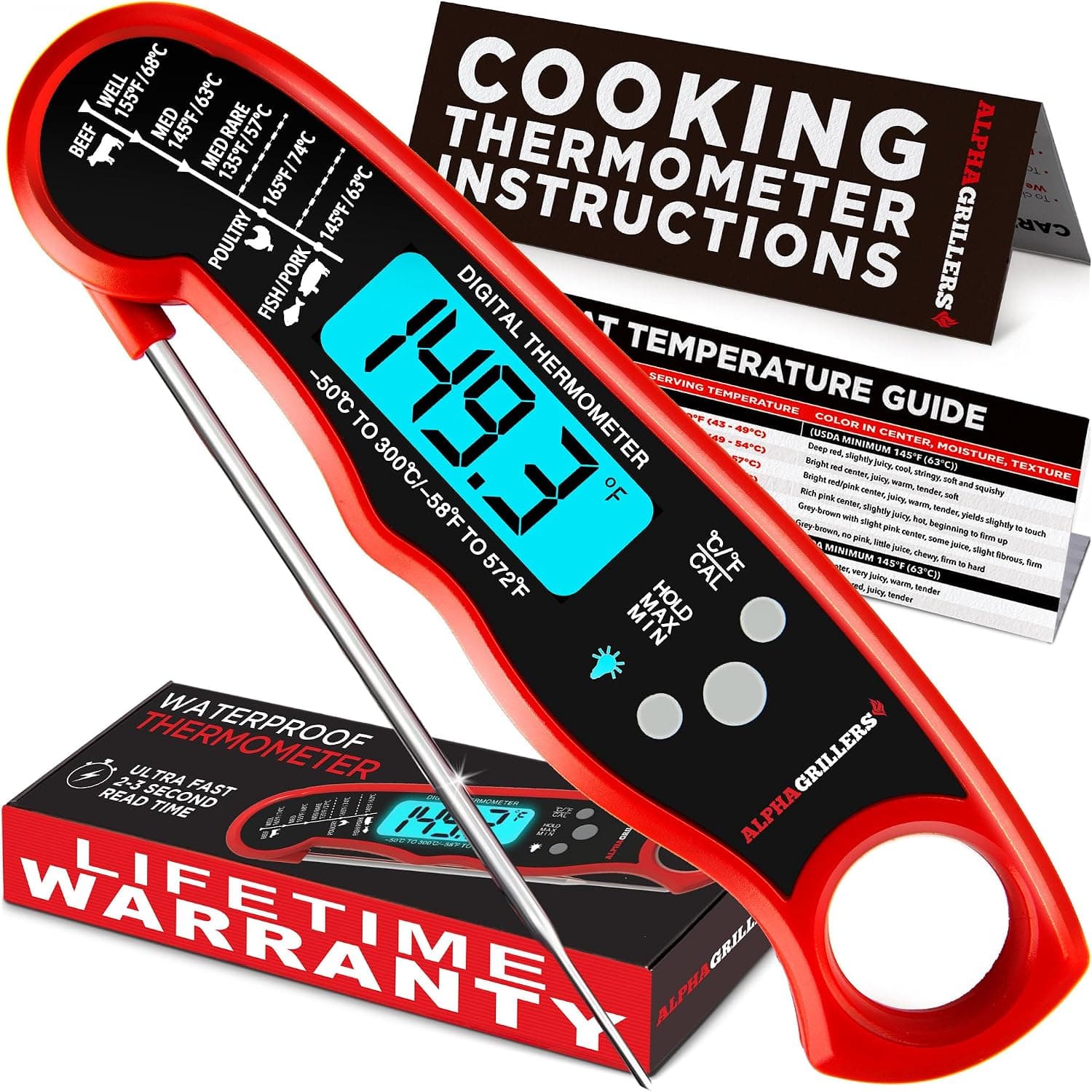
Alpha Grillers Instant Read Meat Thermometer
Best for everyday spot checks at the grate
A straightforward instant-read that covers the job most people actually need: open the lid, get a number in a second or two, close the lid again. The IP67 rating means it survives being rinsed under a tap rather than only wiped, which is usually what decides how long a grill thermometer lasts. It ships pre-calibrated, so the ice-bath check becomes a verification rather than a setup step.
1–2 sec read, IP67, backlit
All the causes side by side
| Cause | How to confirm | Fix time | Part needed | Difficulty |
|---|---|---|---|---|
| Chasing the temperature with the vents | Write down each vent adjustment with the time. If you are adjusting more than about once an hour, the oscillation is being driven by your corrections, not by the cooker. | 1 hour of leaving it alone | None | Easy |
| Fuel added in large, cold lumps | The chart dips right after you add fuel, then overshoots 30–45 minutes later. That is the signature of cold fuel absorbing heat and then all of it catching at once. | 20 minutes | None | Easy |
| Nothing in the chamber to buffer the temperature | An empty or lightly loaded cooker swings hardest. If the problem is worst early in a cook and calms down once a large piece of meat is up to temperature, low thermal mass is the reason. | 10 minutes | None | Easy |
| Wind and ambient temperature swings | The swings correlate with gusts rather than with anything you did. A thin-walled offset or a bullet smoker in an exposed spot is especially vulnerable. | 15 minutes | None | Easy |
| Leaking door or lid gasket | Run the cooker at temperature and watch the seams. Smoke escaping in a steady stream from the firebox door or along the lid line means air is entering somewhere you are not controlling. | 45 minutes | None | Moderate |
| The thermometer is the thing that is swinging | Put a second probe next to the first at grate level. If they disagree, or if one jumps around while the other is steady, you have an instrument problem rather than a fire problem. | 10 minutes | Meat Thermometers & Timers | Easy |
Stop it from coming back
Stability is mostly a fueling habit rather than a piece of equipment. A fire fed small amounts often, with the exhaust wide open and the intake left alone, holds a line that a fire fed in big cold loads never will. Setting up a snake or a minion layout at the start of a long cook means you are not making decisions at hour four when your judgment is worse.
The maintenance side is short: keep the ash out from under the intake so airflow means what you think it means, check the door gasket at the start of each season, and verify the grate probe in an ice bath before you trust a chart it produced. Most cookers that "will not hold temperature" turn out to be leaking air, choked with ash, or reporting fiction.
Related problems
HEAT & FIRE
One Side of the Grill Runs Much Hotter Than the Other
SMOKE & TASTE
Food Tastes Bitter and Over-Smoked
SMOKE & TASTE
No Smoke Ring on the Brisket
TOOLS & GEAR
Meat Thermometer Reading the Wrong Temperature
Questions people actually ask
Plus or minus 15–25°F around your target is normal on a charcoal cooker and does essentially nothing to the finished food. Large cuts have enormous thermal mass and simply average out short excursions. It is worth fixing swings beyond about 50°F, mainly because they usually indicate a fueling or airflow problem that also affects smoke quality.
No. The exhaust stays wide open. Controlling with the exhaust chokes the fire, produces dirty smoke and deposits creosote on the food. All temperature control happens at the intake vent.
Because a cold chunk of wood first absorbs heat and drives moisture off, which drops the chamber temperature, and only then does it ignite and release its energy — often all at once. Smaller pieces added more often, preheated on the firebox, flatten both the dip and the spike.
Yes on a low-and-slow cook. Every lid lift dumps the hot air and the humidity, and recovery takes 10–15 minutes on most cookers. Four unnecessary peeks add an hour to a brisket. Use a leave-in probe so you can watch without opening.
A temperature controller holds a much tighter line and is genuinely useful on long overnight cooks. But it manages airflow into a fire, so it cannot compensate for a leaking door, a choked ash bed or fuel added in large cold loads. Fix those first or you are automating an unstable fire.
Sources
pitandsear participates in the Amazon Services LLC Associates Program. If you buy through a link on this page we may earn a commission at no extra cost to you. Full disclosure.