HEAT & FIRE
One Side of the Grill Runs Much Hotter Than the Other
THE SHORT ANSWER
Every grill has hot spots, but a difference of more than about 75°F across the cooking surface means something is blocking heat distribution. Run the bread test first — cover the grate with slices of white bread over medium heat for ninety seconds and photograph the browning pattern. Cold zones on a gas grill point to blocked burner ports or a warped flame tamer above that burner; on charcoal it usually means the coal bed is uneven or the bottom vents are partly ashed over.
pitandsear participates in the Amazon Services LLC Associates Program. If you buy through a link on this page we may earn a commission at no extra cost to you. Full disclosure.
Check these first (they cost nothing)
- Run the bread test. Cover the whole grate with slices of white bread, close the lid over medium heat for 90 seconds, then photograph the result. The browning pattern is your heat map, and it costs one slice of bread.
- Check which way the wind is blowing. A steady breeze across an open vent cools one end of almost any cooker, and moving the grill 90 degrees can flatten the difference on its own.
- Look at how the food is arranged. A crowded grate blocks convection, so the outside edge runs hot and the center runs cold for reasons that have nothing to do with the burners.
- Confirm you preheated with the lid down. Heat only evens out once the whole chamber is up to temperature; five minutes with the lid open guarantees hot spots.
What's actually causing it
These are ordered deliberately. Number one is the cause that turns out to be the answer most often, so work down the list rather than jumping to the one that sounds most dramatic.
Uneven fuel bed or single-zone charcoal layout
Most commonHow to confirm it
Open the lid and look at the coals. A pile that is two briquettes deep at one side and four at the other, or a bed with visible gaps, produces exactly the pattern the bread test showed.
How to fix it
- Rake the coals into an even layer of consistent depth using a long-handled tool, not a spatula.
- Deliberately bank two thirds of the fuel to one side and leave the other side empty — a planned hot zone and cool zone is far more useful than a failed attempt at uniform heat.
- Check the bottom vents are not partly blocked by ash; ash piled against the intake starves the coals nearest it.
- Let the bed settle for 5 minutes after raking before you judge the result.
Repair or replace — Fix it yourself, every cook. Two-zone layout is the single most useful technique in charcoal grilling and it costs nothing.
Blocked burner ports on one tube
CommonHow to confirm it
With the lid open and all burners on medium, look down the length of each tube. A tube with flames only near the igniter end, or a stretch of dark unlit ports, is your cold zone.
How to fix it
- Shut the gas off at the tank, disconnect it, and let everything cool completely.
- Lift out the grates and flame tamers so the burner tubes are fully visible.
- Work a stiff wire across each blocked port — across the hole, not down into the tube, so debris does not end up inside.
- Brush the outside of the tube along its length, then tap it to shake loose material out of the open end.
- Refit and light. The previously dark section should now carry flame within a few seconds of the rest.
Repair or replace — Fix it yourself. Replace the tube only if the ports have corroded into one another or the metal is perforated.
What you'll need
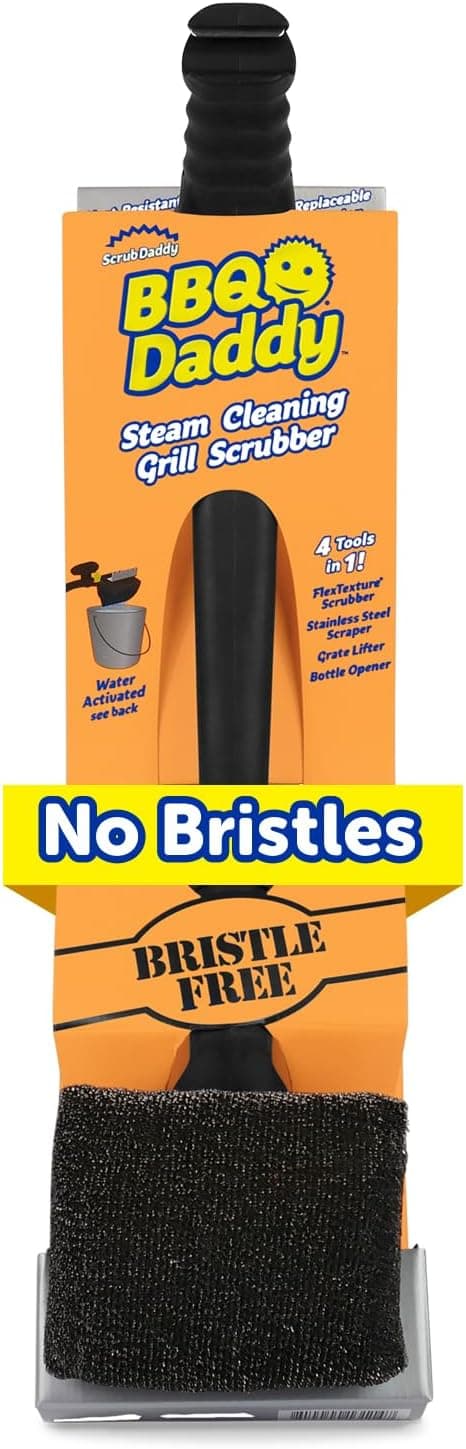 Best Overall
Scrub Daddy
Scrub Daddy BBQ Daddy Grill Brush
Best for cleaning a hot grate with nothing loose to shed
Pairs a steel scraper for hardened carbon with a scrub head made from the temperature-reactive material the brand is known for, which firms up and softens with heat. Being bristle-free removes the failure mode this whole category exists to warn about — there are no loose wires to shed onto the grate. Two cleaning surfaces on one head means you actually use the right one.
Bristle-free, steel scraper + scrub head
Warped or collapsed flame tamers
CommonHow to confirm it
Pull the tamers out and lay them on a flat surface. A tamer that rocks, has a visible bow along its length, or has rusted through in the middle is no longer spreading heat above that burner.
How to fix it
- Compare all the tamers side by side — the warped one is usually obvious once they are next to each other.
- Scrape off the hardened grease with a plastic putty knife; some of the apparent warping is actually build-up.
- Reseat each tamer squarely in its bracket. A tamer sitting proud on one end tips heat toward one side of the chamber.
- Replace any tamer that is perforated or permanently bowed — these are inexpensive model-specific parts.
Repair or replace — Replace the part. A warped tamer cannot be straightened back into service, and it drives flare-ups as well as cold spots.
The grill is simply designed with a hot corner
CommonHow to confirm it
The bread test shows a consistent pattern that does not change after cleaning, and the hot area sits over the flue, the firebox opening, or the rear burner. This is geometry, not a fault.
How to fix it
- Map it once properly with the bread test and remember the map — most people cook on the same grill for years without ever doing this.
- Use the hot area deliberately for searing and the cool area for finishing, rather than fighting for uniformity.
- Rotate food 180 degrees halfway through rather than only flipping it.
- On an offset smoker, a tuning plate or a water pan positioned near the firebox end evens out the gradient considerably.
Repair or replace — Fix it yourself by changing technique. There is nothing broken here — every cooker has a gradient and the useful move is to learn yours.
Heavy grease and carbon build-up insulating one area
Less commonHow to confirm it
Look at the firebox floor and the underside of the grates. A thick crust over part of the chamber acts as insulation, and the area under it runs measurably cooler.
How to fix it
- Let the grill cool, then scrape the firebox floor into the trash with a plastic putty knife.
- Wash the grates and the underside of the bars with hot water and dish soap, then dry with heat.
- Clear the grease drain with a wooden skewer while you are in there.
- Re-run the bread test after the clean to confirm the pattern has actually changed.
Repair or replace — Fix it yourself. This is a cleaning job, and the payoff usually shows up in flare-up frequency as well as heat evenness.
All the causes side by side
| Cause | How to confirm | Fix time | Part needed | Difficulty |
|---|---|---|---|---|
| Uneven fuel bed or single-zone charcoal layout | Open the lid and look at the coals. A pile that is two briquettes deep at one side and four at the other, or a bed with visible gaps, produces exactly the pattern the bread test showed. | 5 minutes | None | Easy |
| Blocked burner ports on one tube | With the lid open and all burners on medium, look down the length of each tube. A tube with flames only near the igniter end, or a stretch of dark unlit ports, is your cold zone. | 45 minutes | Grill Brushes & Scrapers | Moderate |
| Warped or collapsed flame tamers | Pull the tamers out and lay them on a flat surface. A tamer that rocks, has a visible bow along its length, or has rusted through in the middle is no longer spreading heat above that burner. | 30 minutes | None | Moderate |
| The grill is simply designed with a hot corner | The bread test shows a consistent pattern that does not change after cleaning, and the hot area sits over the flue, the firebox opening, or the rear burner. This is geometry, not a fault. | 15 minutes | None | Easy |
| Heavy grease and carbon build-up insulating one area | Look at the firebox floor and the underside of the grates. A thick crust over part of the chamber acts as insulation, and the area under it runs measurably cooler. | 1 hour | None | Moderate |
Stop it from coming back
Uneven heat creeps back because grease and carbon accumulate faster in some parts of a firebox than others, and because flame tamers slowly warp under repeated heat cycling. Neither is dramatic enough to notice week to week, which is why the bread test is worth repeating at the start of every season — it turns a slow drift into something you can see.
The other half of prevention is accepting the gradient rather than fighting it. Map your grill once, cook with a deliberate hot zone and cool zone, and rotate food as well as flipping it. A cooker with a known 75°F spread that you use on purpose beats one you keep trying to make uniform.
Related problems
Questions people actually ask
A spread of 25–50°F across a domestic cooking surface is entirely normal and most grills show it. Once the difference exceeds about 75°F you are into something that is worth diagnosing — that is enough to have one side searing while the other is barely browning.
It works well because it makes a temperature gradient visible in one photograph. Use plain white bread, cover the whole grate, close the lid, and pull the slices at 90 seconds over medium heat. The darkest slices show your hot zone. It is cruder than a probe grid but it maps the whole surface at once.
No. Two-zone cooking is deliberately uneven, and it is what lets you sear something and then finish it through without burning the outside. The goal is a gradient you understand and control, not a uniform slab of heat.
Most pellet grills run hotter directly above the firepot and near the exhaust. That is inherent to the design rather than a fault. Some models offer a slotted heat diffuser or a drip tray you can shift to even out the pattern; otherwise, rotate the food.
Yes, and it is badly underestimated. A breeze across an intake vent drives the fire harder at that end, and a breeze across the body strips heat from the windward side. Turning the grill so the vents face away from the wind, or setting up a windbreak that is well clear of the cooker, often fixes what looks like an equipment fault.
Sources
pitandsear participates in the Amazon Services LLC Associates Program. If you buy through a link on this page we may earn a commission at no extra cost to you. Full disclosure.