OPEN FIRE
Hot Dogs Keep Falling Off the Skewer
THE SHORT ANSWER
A hot dog on one prong is free to rotate, and once it rotates the hole widens and it slides off. Push the food on lengthways through the long axis with a two-prong fork, entering at a slight angle so the tines take different paths through the meat, and stop about an inch short of pushing the tips through the far end. Cook it further from the flame — the casing that splits and softens is what finally lets go.
pitandsear participates in the Amazon Services LLC Associates Program. If you buy through a link on this page we may earn a commission at no extra cost to you. Full disclosure.
Check these first (they cost nothing)
- Count the prongs. A single point lets the food rotate, and once it rotates the hole widens until it lets go.
- Check the entry angle. Straight down the center makes a clean tunnel; entering at a slight angle so the tines take different paths locks it in place.
- Look at how far the tips have gone. Pushing them through the far end removes the anchor at the tip.
- Notice how close to the flame you are cooking. A casing that splits and softens is what finally releases the food, and that is a heat problem.
What's actually causing it
These are ordered deliberately. Number one is the cause that turns out to be the answer most often, so work down the list rather than jumping to the one that sounds most dramatic.
Single-prong skewer letting the food rotate
Most commonHow to confirm it
The sausage spins freely on the stick when you turn it. That rotation reams the hole a little wider each time until nothing is holding it.
How to fix it
- Switch to a two-prong fork so the food is pinned on two axes.
- Push the food on lengthways through its long axis rather than skewering it across.
- Enter at a slight angle so the two tines take visibly different paths through the meat.
- If you only have a single-prong stick, run it in at a diagonal rather than straight down the center.
Repair or replace — Replace the skewer with a two-prong fork. A single point cannot hold a cylinder, whatever your technique.
What you'll need
 Best Overall
MalloMe
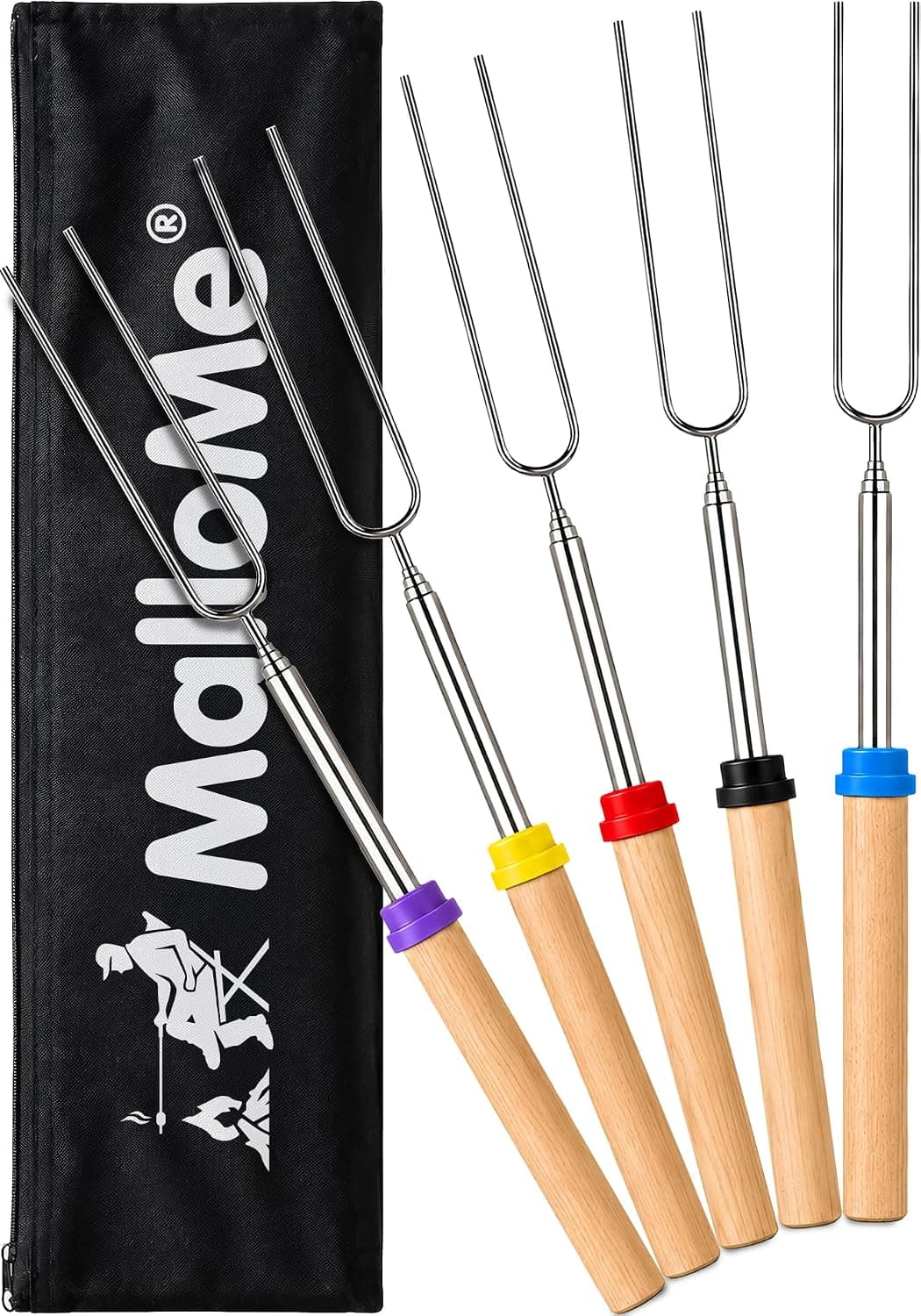
MalloMe Roasting Sticks, 32 inch, 5-pack
Best for family s’mores nights
Five telescoping steel skewers at 32 inches extended, which is the length that keeps forearms clear of the radiant heat of a normal fire pit without making the tip hard to aim. Collapsing them is what makes a set of five practical to store. Built for marshmallows and hot dogs alike, so the prong design handles food that would spin on a single point.
32 in extended, 5-pack, telescoping steel
Tips pushed all the way through the far end
CommonHow to confirm it
The prong tips are visible out the end of the sausage. There is nothing gripping at the tip, so the food is held only by friction along the shaft.
How to fix it
- Stop about an inch short of the far end so the tips stay buried in intact meat.
- Push with a slow twisting motion rather than forcing it, which tears a wider channel.
- If the tips have already gone through, pull the food back an inch rather than pushing it further on.
- For a longer sausage, enter from the end rather than the side so the whole length is on the tines.
Repair or replace — Fix it yourself. Purely a technique adjustment and it costs nothing.
Cooking too close to the flame so the casing splits
CommonHow to confirm it
The skin has burst along its length before the food fell off. A split casing loses all its structural integrity, and the soft interior slides off the tines.
How to fix it
- Roast over glowing coals rather than over flame — six inches above embers, not eighteen above a burning log.
- Turn the food continuously rather than parking one face against the heat.
- Score the casing lightly if you are cooking a thick sausage, so pressure escapes without a burst.
- Cook to temperature: 160°F for pork or beef sausage, 165°F for anything containing poultry.
Repair or replace — Fix it yourself by moving away from the flame. This also fixes the burnt-outside problem at the same time.
Food went on frozen or straight from the refrigerator
CommonHow to confirm it
The skewer went in hard and possibly tore the meat, or the sausage cracked as it was pushed on. Cold meat is brittle and resists the tines rather than closing around them.
How to fix it
- Let sausages sit out for 15–20 minutes before skewering so they are pliable.
- Never skewer anything still frozen — thaw it fully first.
- Push slowly with a twisting motion so the meat parts around the tine rather than tearing.
- If the meat has torn, use that piece for the grill grate rather than the fire.
Repair or replace — Fix it yourself. Twenty minutes on the counter solves it and improves how evenly it cooks.
Prongs too thick or too widely spaced for the food
Less commonHow to confirm it
The tines tear a visibly oversized channel, or they are spread wider than the sausage so only one is actually in the meat.
How to fix it
- Match the fork to what you cook most — narrow tine spacing for sausages and hot dogs, wider for larger items.
- Look for prongs under about 3 mm; thick tines destroy the structure they are supposed to grip.
- For very soft food, thread it on lengthways so a much greater length of tine is in contact.
- Do not try to bend prongs closer together — the metal fatigues at the bend and snaps.
Repair or replace — Replace the fork with one sized for the job. Bending the prongs is not a repair, it is a future failure.
What you'll need
How to choose barbecue forks & roasting skewers →All the causes side by side
| Cause | How to confirm | Fix time | Part needed | Difficulty |
|---|---|---|---|---|
| Single-prong skewer letting the food rotate | The sausage spins freely on the stick when you turn it. That rotation reams the hole a little wider each time until nothing is holding it. | 2 minutes | Barbecue Forks & Roasting Skewers | Easy |
| Tips pushed all the way through the far end | The prong tips are visible out the end of the sausage. There is nothing gripping at the tip, so the food is held only by friction along the shaft. | 1 minute | None | Easy |
| Cooking too close to the flame so the casing splits | The skin has burst along its length before the food fell off. A split casing loses all its structural integrity, and the soft interior slides off the tines. | 10 minutes | None | Moderate |
| Food went on frozen or straight from the refrigerator | The skewer went in hard and possibly tore the meat, or the sausage cracked as it was pushed on. Cold meat is brittle and resists the tines rather than closing around them. | 20 minutes | None | Easy |
| Prongs too thick or too widely spaced for the food | The tines tear a visibly oversized channel, or they are spread wider than the sausage so only one is actually in the meat. | 5 minutes | Barbecue Forks & Roasting Skewers | Easy |
Stop it from coming back
Two prongs and a shallow entry angle solve this permanently. A single point lets a cylinder rotate, and every rotation reams the hole wider until the food drops; two tines taking different paths through the meat cannot rotate at all. Enter through the long axis, push with a slow twist rather than forcing it, and stop about an inch short so the tips stay anchored in intact meat.
The rest is heat management. A casing that splits has lost the structure holding it on the tines, and casings split when they are cooked hard over flame rather than gently over coals. Let sausages come up from refrigerator temperature for twenty minutes so they are pliable when skewered, roast over embers, turn continuously, and cook to 160°F — or 165°F for anything containing poultry — rather than to appearance.
Related problems
OPEN FIRE
Roasting Sticks Bend and Drop the Marshmallow
OPEN FIRE
Campfire Is Too Hot to Roast Anything Properly
COOKING FAULTS
Chicken Burnt on the Outside, Raw in the Middle
TOOLS & GEAR
Meat Thermometer Reading the Wrong Temperature
Questions people actually ask
Raw pork or beef sausage must reach 160°F, and anything containing poultry must reach 165°F. Pre-cooked hot dogs only need heating through, but USDA guidance is to heat them to 165°F. A charred exterior over an open fire tells you nothing about the center.
Lengthways, through the long axis. It puts far more tine in contact with the meat, it stops the food rotating, and it exposes the whole length evenly to the heat. Crossways gives you a short contact length and a natural pivot point.
Steam pressure inside the sausage with nowhere to go, driven by cooking too fast over direct flame. Move to coals, turn continuously, and score a thick casing lightly so pressure escapes gradually rather than bursting it.
Not necessarily, but it makes life easier with thick raw sausages. Simmering them gently first means the fire is only browning the outside rather than trying to cook the center through, which is what causes both the splitting and the burnt-outside-raw-inside problem.
For food that tends to spin, yes — a flat blade cannot rotate in the channel it cuts, which is the same principle as using two prongs. Flat skewers are more common for kebabs than for campfire forks, but the geometry works the same way.
Sources
pitandsear participates in the Amazon Services LLC Associates Program. If you buy through a link on this page we may earn a commission at no extra cost to you. Full disclosure.