CORROSION & WEATHER
Mold and Mildew Growing Under the Grill Cover
THE SHORT ANSWER
Mold under a cover means moisture is being sealed in, usually because the cover went on while the grill was still warm or still damp. Clean the affected surfaces with hot soapy water, then run the grill at high heat for fifteen minutes with the lid closed to sterilize the interior. Wash the cover itself, dry it completely, and from now on only cover a grill that is cold and dry — and choose a cover with vents.
pitandsear participates in the Amazon Services LLC Associates Program. If you buy through a link on this page we may earn a commission at no extra cost to you. Full disclosure.
Check these first (they cost nothing)
- Look at the inside face of the cover. Condensation beads there mean the cover is sealing moisture in rather than keeping it out.
- Check whether the cover has vents. If it does not, that is the design problem and no amount of cleaning changes it.
- Think back to when the cover went on last time. A warm grill under a cover steams itself for hours.
- Check for food residue left in the chamber. Mold needs something organic to grow on, and grease and scraps are exactly that.
What's actually causing it
These are ordered deliberately. Number one is the cause that turns out to be the answer most often, so work down the list rather than jumping to the one that sounds most dramatic.
The cover went on while the grill was still warm or damp
Most commonHow to confirm it
Growth is heaviest on the underside of the lid and the inside of the cover — the surfaces where rising vapor condenses first.
How to fix it
- Wash the affected metal surfaces with hot water and dish soap, then rinse.
- Run the grill on high with the lid closed for 15 minutes to dry and sterilize the interior.
- Wash the cover itself with mild soap and air-dry it completely before it goes back on.
- From now on, only cover a grill you can put your bare hand flat on, and only when it is dry.
Repair or replace — Fix it yourself. The cleaning takes an hour; the habit change is what prevents the repeat.
The cover has no vents
CommonHow to confirm it
Inspect both sides of the cover for mesh panels or grommeted openings. A completely sealed cover traps every bit of evaporating moisture against the metal.
How to fix it
- Replace it with a cover that has air vents on both sides — this matters more than fabric weight.
- Check the fit clears the lid handle and side shelves, which is where covers wear through first.
- Make sure the hem clears the ground rather than dragging and wicking water upward.
- Secure it with straps or a drawstring so wind cannot flap it against the cabinet edges.
Repair or replace — Replace the cover. An unvented cover causes more moisture damage than leaving the grill uncovered.
What you'll need
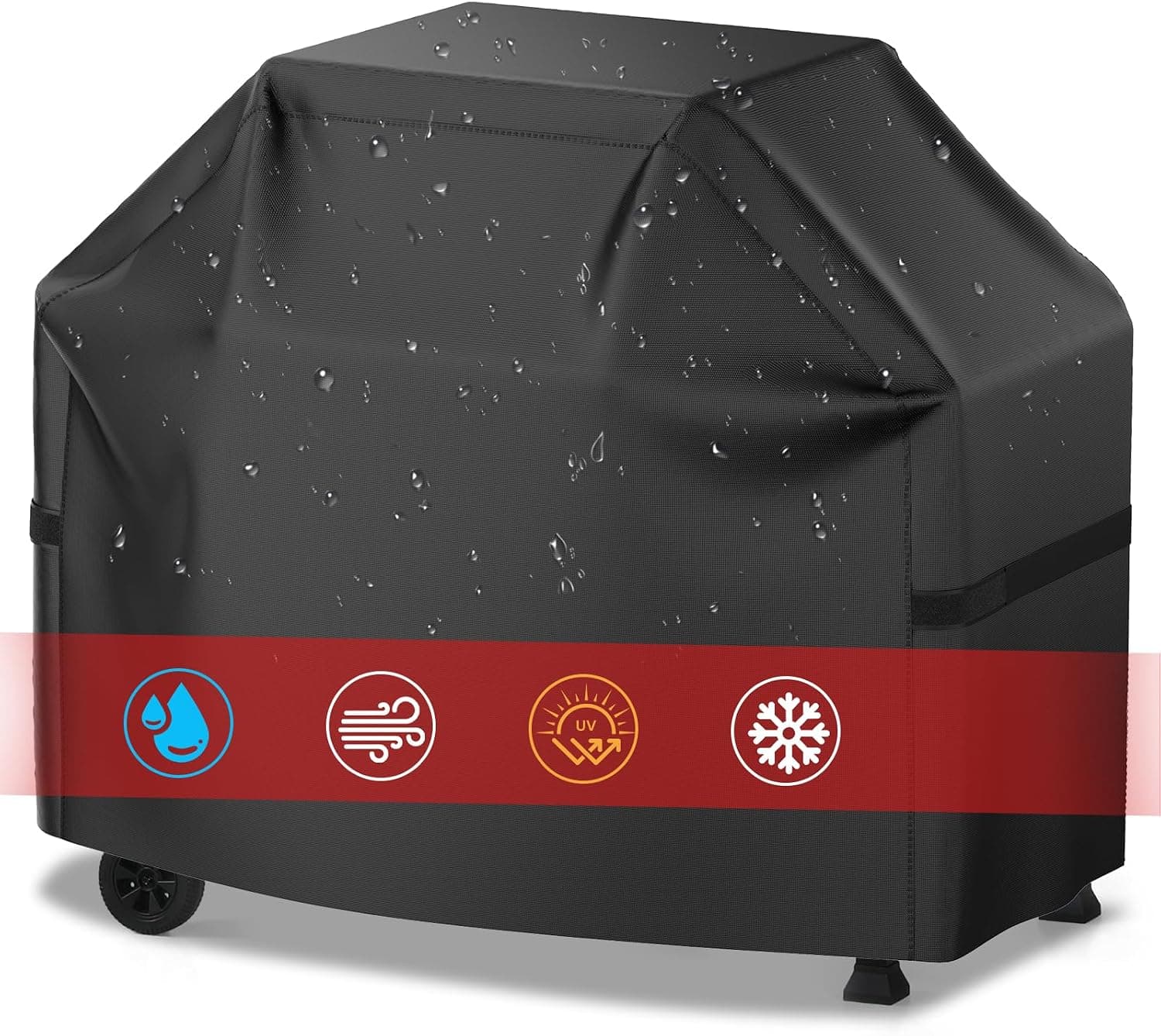 Best Overall
VIBOOS
VIBOOS Grill Cover, 58 inch
Best for exposed patios that get wind as well as rain
Wind is what destroys covers, so hook-and-loop straps plus a drawstring hem matter more than most buyers expect — an unsecured cover flaps and abrades itself against the cabinet edges. Waterproof and anti-UV with a rip-proof fabric. At 58 inches it suits most three to four burner gas grills.
58 in, waterproof, straps + drawstring
Food residue and grease left in the chamber
CommonHow to confirm it
Growth is concentrated on the grates, the drip tray and the firebox floor rather than on clean metal. Mold needs an organic food source, and grease is one.
How to fix it
- Scrape the firebox floor and the tray into the trash with a plastic putty knife.
- Wash the grates and tamers in hot water with dish soap and dry them with heat.
- Empty and wash the grease cup.
- Run the grill hot for 15 minutes before the next cook to sterilize the interior surfaces.
Repair or replace — Fix it yourself. A clean firebox has nothing for mold to live on, which is the real prevention.
Stored in a permanently damp or shaded spot
CommonHow to confirm it
Growth returns within weeks of every clean, and other things nearby — fence panels, decking, planters — show the same pattern. Deep shade with poor air movement is the classic setting.
How to fix it
- Move the grill somewhere with more sun and air movement if you possibly can.
- Raise it off the ground on pavers or a floor pad so meltwater and standing water cannot wick into the base.
- Air the cover off entirely on dry days rather than leaving it sealed for months.
- In a genuinely wet climate, store the grill in a garage or shed over winter, with the propane tank left outside.
Repair or replace — Fix it yourself by relocating. The environment is the cause, so cleaning alone will always be temporary.
The cover fabric itself has gone porous and is holding water
Less commonHow to confirm it
Water no longer beads on the outside of the cover, the coating looks chalky, or seams have split. The fabric is now a wet blanket rather than a shield.
How to fix it
- Test it by pouring a cup of water on the outside — a sound cover beads and sheds it.
- Check the seams; stitched seams are needle holes in a waterproof layer unless they have been taped or welded.
- Replace a cover that has gone chalky, split at the seams or lost its beading.
- Choose a heavier denier if the grill sits fully exposed to sun and wind year round.
Repair or replace — Replace the cover. Reproofing sprays are a short-term patch on a cover that is already failing.
What you'll need
How to choose grill covers →All the causes side by side
| Cause | How to confirm | Fix time | Part needed | Difficulty |
|---|---|---|---|---|
| The cover went on while the grill was still warm or damp | Growth is heaviest on the underside of the lid and the inside of the cover — the surfaces where rising vapor condenses first. | 1 hour | None | Moderate |
| The cover has no vents | Inspect both sides of the cover for mesh panels or grommeted openings. A completely sealed cover traps every bit of evaporating moisture against the metal. | 10 minutes | Grill Covers | Easy |
| Food residue and grease left in the chamber | Growth is concentrated on the grates, the drip tray and the firebox floor rather than on clean metal. Mold needs an organic food source, and grease is one. | 1 hour | None | Moderate |
| Stored in a permanently damp or shaded spot | Growth returns within weeks of every clean, and other things nearby — fence panels, decking, planters — show the same pattern. Deep shade with poor air movement is the classic setting. | 30 minutes | None | Easy |
| The cover fabric itself has gone porous and is holding water | Water no longer beads on the outside of the cover, the coating looks chalky, or seams have split. The fabric is now a wet blanket rather than a shield. | 10 minutes | Grill Covers | Easy |
Stop it from coming back
Mold under a cover is a moisture-balance problem, not a hygiene problem. Every grill holds residual moisture after a cook or a wash, and if the cover seals that vapor in it condenses on cold metal and sits there for days. Two rules prevent essentially all of it: only cover a grill that is cold and dry to the touch, and only use a cover with vents on both sides.
The rest is removing what mold feeds on. A firebox scraped clean of grease and a grease cup emptied on schedule gives spores nothing to colonize. Wash the cover itself at least once a season and air-dry it fully — mold grows on the fabric as readily as on the grill, and a cover put back damp simply reinfects the surfaces underneath.
Related problems
Questions people actually ask
Yes, once it has been cleaned and heated. Wash the affected surfaces with hot soapy water, rinse, then run the grill at high heat with the lid closed for about 15 minutes. Grill temperatures are far above what mold survives, so a proper burn-off sterilizes the interior.
Hot water and dish soap followed by a high-heat burn-off is the better route, and it avoids leaving chlorine residue on cooking surfaces. If you do use a diluted bleach solution on the outside or the cover, rinse thoroughly and never mix it with any ammonia-based cleaner.
Only if it has vents. Fabric weight and coating quality determine how long a cover survives sun and wind; vents determine whether it traps moisture. A heavy unvented cover will grow mold underneath just as readily as a cheap one.
Until you can rest a flat hand on the lid comfortably — usually an hour or more after a hot cook, and longer for anything with heavy cast iron or ceramic. If it is warm enough to feel, it is warm enough to steam under a cover.
No, and this is the single most common cause of the problem. A cover over a wet cooker seals the water in for however long it stays on. If you have to protect it from imminent rain, leave the cover loose or propped rather than strapped down, and come back to fit it properly once things are dry.
Sources
pitandsear participates in the Amazon Services LLC Associates Program. If you buy through a link on this page we may earn a commission at no extra cost to you. Full disclosure.