RESIDUE & DEBRIS
Black Flakes Coming Off the Grates Onto Food
THE SHORT ANSWER
Crush a flake between your fingers. If it smears into black powder it is carbonized grease, which is harmless but means the grates need a proper burn-off and scrape. If the flake is hard, curved and shiny on one side it is porcelain enamel or a coating failing, and those grates should be replaced rather than cleaned — once the coating starts shedding it will keep shedding.
pitandsear participates in the Amazon Services LLC Associates Program. If you buy through a link on this page we may earn a commission at no extra cost to you. Full disclosure.
Check these first (they cost nothing)
- Crush a flake between your fingers. Black powder means carbonized grease. A hard, curved chip that will not crush means a coating is failing.
- Look at the underside of the lid with a flashlight. Grills are not painted inside, so anything flaking off there is cooked-on grease, not paint.
- Run a hand along the underside of the grate bars. That is where residue builds up unseen, and it is where most flakes actually come from.
- Check the brush before you blame the grate. A shedding wire brush leaves debris that looks similar and is a much more serious problem.
What's actually causing it
These are ordered deliberately. Number one is the cause that turns out to be the answer most often, so work down the list rather than jumping to the one that sounds most dramatic.
Carbonized grease shedding from the lid and grates
Most commonHow to confirm it
The flakes crush into black powder, they come off the underside of the lid or the bars, and they increase after a period of heavy cooking without a deep clean.
How to fix it
- Run the grill on high with the lid closed for 15–20 minutes to dry and carbonize the deposit.
- Let it cool, then scrape the underside of the lid with a plastic putty knife — the dry deposit lifts off in sheets.
- Scrape along the length of each grate bar and then the underside of each bar.
- Vacuum or brush the debris out of the firebox rather than letting it sit on the tamers.
- Wipe the bars with a lightly oiled cloth while the grill is still warm.
Repair or replace — Fix it yourself. Harmless material, but it keeps coming until the deposit is physically removed.
What you'll need
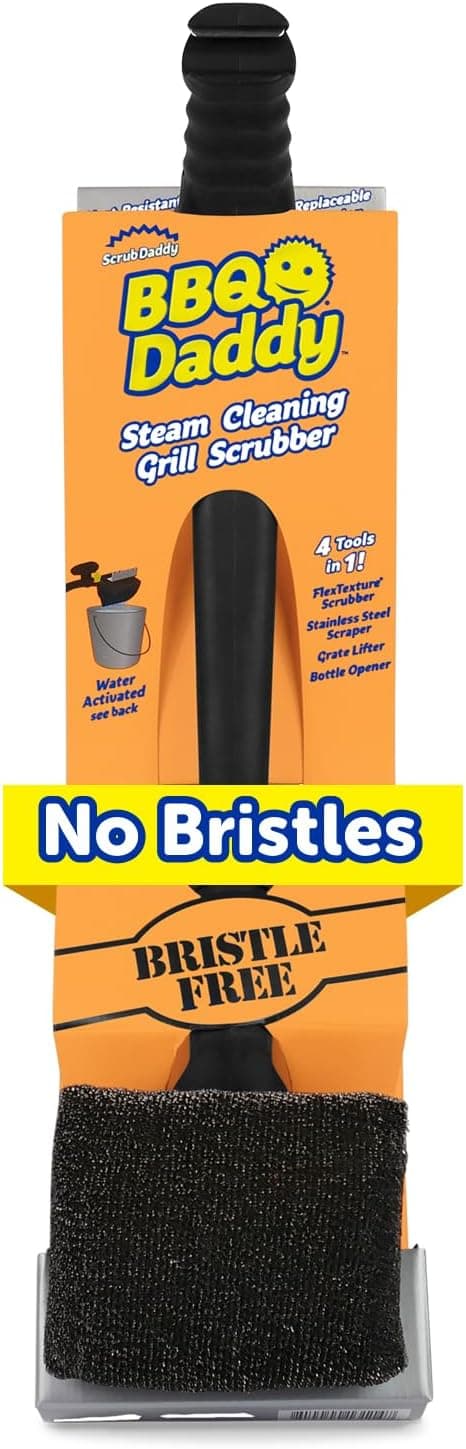 Best Overall
Scrub Daddy
Scrub Daddy BBQ Daddy Grill Brush
Best for cleaning a hot grate with nothing loose to shed
Pairs a steel scraper for hardened carbon with a scrub head made from the temperature-reactive material the brand is known for, which firms up and softens with heat. Being bristle-free removes the failure mode this whole category exists to warn about — there are no loose wires to shed onto the grate. Two cleaning surfaces on one head means you actually use the right one.
Bristle-free, steel scraper + scrub head
Porcelain enamel coating failing
CommonHow to confirm it
The flakes are hard, slightly curved, and glossy on one side. Look for chipped patches on the bars where dull gray cast iron is showing through the coating.
How to fix it
- Stop using any metal brush on the grate immediately — wire accelerates the failure.
- Inspect the whole grate under a bright light and note how many bars are affected.
- Accept that a shedding porcelain grate cannot be repaired, recoated or reseasoned.
- Replace it with the model-specific part, or switch to bare cast iron or stainless and season it.
Repair or replace — Replace the grate. Once the coating starts shedding it will keep shedding, and the chips end up in food.
Nonstick or ceramic coating breaking down
CommonHow to confirm it
Applies to coated grill mats, coated grates and griddle surfaces. The coating looks scratched, dull or bubbled, and flakes lift at the edges of scratches.
How to fix it
- Check the manufacturer’s stated maximum temperature — most coated surfaces are not rated for the 600°F-plus a grill reaches on high.
- Stop using metal tools on the surface and switch to wood or silicone.
- Retire any coated mat or surface that is visibly flaking. There is no way to stabilize it.
- For grilling at searing temperatures, use bare cast iron or stainless instead of a coated surface.
Repair or replace — Replace it. A degraded coating cannot be repaired and will keep shedding into the food.
Rust scale from bare or pitted metal
CommonHow to confirm it
The flakes are reddish-brown rather than black, and they leave an orange smear on a white cloth. The grate feels rough rather than smooth.
How to fix it
- Scrub a small area with a nylon pad and hot water to see whether bright metal appears underneath.
- If it does, scrub the whole grate back, dry with heat, and reseason with a thin coat of high-smoke-point oil at 400–450°F.
- If the surface is pitted and the rust returns within a day, the grate has lost material and should be replaced.
- Never wire-wheel a porcelain-coated bar — it destroys the coating you are trying to save.
Repair or replace — Clean and reseason if it is surface rust on cast iron or steel. Replace if the metal is pitted or the bars flex.
Ash and fuel debris blowing onto the food
Less commonHow to confirm it
Happens on charcoal and pellet cookers, worst when the ash pan is full or on a windy day. The flakes are light gray and weightless rather than greasy.
How to fix it
- Empty the ash catcher when it reaches about half full, not when it overflows.
- On a pellet grill, vacuum the firepot and chamber floor every 40–60 hours of cooking.
- Let the fuel settle for a few minutes after raking or adding before the food goes on.
- Reposition the cooker so wind is not blowing straight across the intake vents into the chamber.
Repair or replace — Fix it yourself. Emptying ash regularly also fixes airflow problems you have probably been blaming on the vents.
All the causes side by side
| Cause | How to confirm | Fix time | Part needed | Difficulty |
|---|---|---|---|---|
| Carbonized grease shedding from the lid and grates | The flakes crush into black powder, they come off the underside of the lid or the bars, and they increase after a period of heavy cooking without a deep clean. | 45 minutes | Grill Brushes & Scrapers | Moderate |
| Porcelain enamel coating failing | The flakes are hard, slightly curved, and glossy on one side. Look for chipped patches on the bars where dull gray cast iron is showing through the coating. | 20 minutes | None | Moderate |
| Nonstick or ceramic coating breaking down | Applies to coated grill mats, coated grates and griddle surfaces. The coating looks scratched, dull or bubbled, and flakes lift at the edges of scratches. | 15 minutes | None | Easy |
| Rust scale from bare or pitted metal | The flakes are reddish-brown rather than black, and they leave an orange smear on a white cloth. The grate feels rough rather than smooth. | 1 hour plus seasoning | None | Involved |
| Ash and fuel debris blowing onto the food | Happens on charcoal and pellet cookers, worst when the ash pan is full or on a windy day. The flakes are light gray and weightless rather than greasy. | 10 minutes | None | Easy |
Stop it from coming back
Black flakes are almost always a maintenance debt coming due. Grease deposited on the lid and the underside of the bars builds slowly, carbonizes, and eventually loses its grip — usually onto whatever you are cooking. Scraping the bars top and bottom after every cook, while they are still hot, keeps the deposit from ever reaching that point.
The coating side of this cannot be prevented by cleaning, only by not accelerating it. Keep metal brushes off porcelain and nonstick surfaces, use brass or nylon on coated bars, and respect the manufacturer’s maximum temperature. Once a coating starts chipping the only honest answer is replacement, so the goal is to make it last rather than to rescue it.
Related problems
Questions people actually ask
Small amounts of carbonized food residue are not considered a specific hazard, and it is essentially the same material as the char on the outside of grilled food. It tastes bitter and it is unpleasant, which is reason enough to clean it off. Hard coating chips are a different matter and should not be eaten.
No. Grill lids are not painted on the inside — there is no coating there to peel. What flakes off is grease and smoke residue that has carbonized into a layer. Scrape it off dry with a plastic scraper once it has been baked hard.
Rub one on a white paper towel. Carbon leaves a black smear and crushes to powder. Rust leaves an orange-brown smear and the flake feels harder and more brittle. Coating chips leave no smear at all and have one glossy face.
No. There is no consumer product that reliably recoats porcelain enamel at grill temperatures, and patch attempts fail quickly. Once chips are lifting, replace the grate — the cost of a replacement is far below the nuisance of picking chips out of food all season.
It helps but it does not finish the job. Running the grill on high dries and carbonizes the deposit so it becomes brittle, which is what makes it scrapeable. The mechanical scraping afterwards is what actually removes it — heat alone just relocates the problem to the next cook.
Sources
pitandsear participates in the Amazon Services LLC Associates Program. If you buy through a link on this page we may earn a commission at no extra cost to you. Full disclosure.